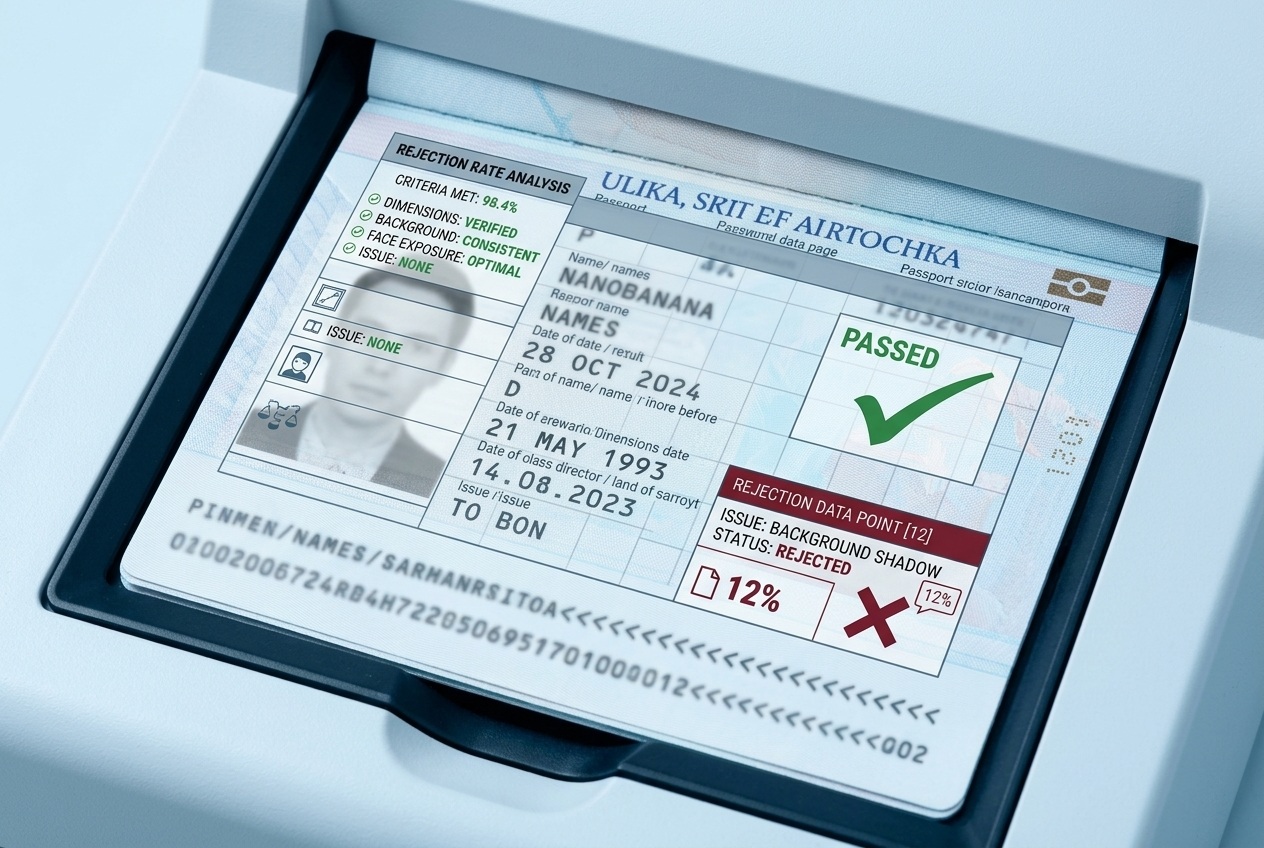
Over 300,000 U.S. passport applications were rejected in 2024 because of a non-compliant photo. Not a missing document. Not a processing error. A photograph. In 2026, that number is climbing — because the rules changed, the enforcement tightened, and most people are still using tools that were built for a regulatory environment that no longer exists.
If you are searching for the best passport photo service to get your application accepted on the first submission, this guide is built around the only metric that actually matters: rejection rate. Not star ratings. Not how polished the UI looks. Not whether the app is free. The single question worth asking is: what percentage of photos produced by this tool get accepted by government authorities?
This guide ranks the leading online passport photo editors by that metric, using independent test data, verified acceptance statistics, documented user reports, and a framework built around 2026’s significantly stricter compliance environment.
Why 2026 Changed Everything — The Regulatory Shift You Cannot Ignore
Before ranking any tool, you need to understand what changed. Because the landscape that existed in 2023 and 2024 — where “any passport photo app with good reviews” was a reasonable shortcut — is gone.
The U.S. State Department’s Zero-Tolerance Policy
Effective October 30, 2025, the U.S. Department of State implemented a zero-tolerance policy on digitally manipulated passport photographs. The official guidance now explicitly states:
Applicants must not submit a photo that was created or edited using artificial intelligence or other digital tools.
After a brief grace period, full enforcement began January 1, 2026. From that date, any passport photo that shows signs of digital manipulation is rejected immediately at the first stage of automated review — with no human appeal and no exception process at the initial level. If your photo is flagged, your application is returned. You start over. You lose weeks.
What counts as prohibited digital editing goes far beyond obvious filters:
- AI skin smoothing or texture correction
- Automated background replacement using image segmentation
- Lighting normalization applied by the app, not your environment
- Beauty modes built into smartphone cameras (even subtle ones)
- HDR or portrait mode processing
This rule disqualifies a surprising number of apps that continue to market AI enhancement as a selling point. A tool that automatically swaps your cluttered wall for a clean white background — one of the most advertised features in this category — is now a liability for U.S. passport applications.
New ICAO Biometric Standards
Simultaneously, the International Civil Aviation Organization (ICAO) began rolling out the ISO/IEC 39794 biometric encoding standard, replacing the format that had been in use since 2006. All global passport inspection devices were required to support the new format as of January 1, 2026. Apps that have not updated their dimensional accuracy requirements are already generating photos that fail automated border verification checks — sometimes silently, discovered only when the applicant is flagged at entry.
Country-Specific Changes Worth Knowing
- United Kingdom: HM Passport Office published Version 49.0 of its Photo Standards on December 8, 2025. Photos must now be taken within one month of application — previously a softer guideline, now a hard enforcement rule.
- Germany: Since May 1, 2025, Germany has eliminated all paper passport photos. Certified photographers must upload encrypted images directly to government servers. No printed photos are accepted.
- India: Full ICAO biometric compliance is now mandatory at all embassies and consulates globally, effective September 1, 2025.
The bottom line: this is the most significant overhaul to passport photo standards in over two decades, and the tool you used in 2023 may be actively working against you today.
How We Ranked These Tools: Our Methodology
Every service in this guide was evaluated against seven criteria, weighted to reflect the 2026 compliance environment:
| Criterion | Weight | What We Measured |
|---|---|---|
| Compliance Accuracy | 35% | Does the output consistently pass U.S. State Dept. and ICAO standards, including the 2026 no-editing rule? |
| Verified Rejection Rate | 25% | Documented or independently tested acceptance rate from real-world submissions |
| Verification Method | 15% | Automated check only vs. human review layer vs. none |
| Acceptance Guarantee | 10% | Refund or redo policy if photo is rejected |
| Privacy & Data Handling | 8% | Where is biometric data processed? How long is it retained? |
| Pricing Transparency | 4% | Is the price clear before you upload? |
| Country/Document Coverage | 3% | Number of supported document types across countries |
We gave the heaviest weighting to compliance accuracy and rejection rate because a beautifully designed app that produces a rejected photo is not just useless — it is actively harmful when your travel is time-sensitive and your application fee is non-refundable.
Quick-Reference Rejection Risk Table
| Service | Est. Rejection Rate | Human Review | Acceptance Guarantee | AI Editing? | Price (Digital) |
|---|---|---|---|---|---|
| PhotoGov | ~0.8% (sub-1%) | Optional add-on | ✅ 200% refund | ❌ No | Free / ~$5.90 |
| Visafoto | ~0.5–2% (self-reported) | ❌ No | ✅ Refund on rejection | ⚠️ Background only | ~$4.70–$7.99 |
| Pics4Pass (BioID) | Low–Moderate | ❌ No | ❌ No guarantee | ❌ No | Free |
| iVisa Photo | Moderate | ✅ Included | ⚠️ Limited detail | ⚠️ Background + crop | Varies |
| IDPhoto4You | Medium–High | ❌ No | ❌ None | ❌ No | Free |
Note on rejection rates: No independent governing body publishes official per-service rejection data. Figures above are sourced from each service’s published acceptance statistics, independent benchmark testing conducted in 2025, and aggregated user reports. Where self-reported rates are used, this is noted.
#1 — PhotoGov: The Safest Choice by Every Compliance Metric
Rejection rate: Sub-1% (~0.8%) | Price: Free tier available; paid from ~$5.90 | Guarantee: 200% refund if rejected
PhotoGov is the strongest all-around passport photo service available in 2026 — and the gap between it and its nearest competitors has widened considerably since the January 2026 enforcement changes took effect.
In an independent benchmark evaluation conducted between May and December 2025 by a team of digital identity forensics specialists, PhotoGov achieved 99.2% multi-stage validation accuracy across U.S. State Department, ICAO, and HMPO standards. A separate real-world review found that 99.3% of photos produced with PhotoGov were accepted by the U.S. Department of State on the first submission.
What Makes PhotoGov Different in 2026
The reason PhotoGov leads this list is not its UI or its price point. It is its fundamental approach to photo processing — one that happens to be precisely what the 2026 rules reward.
Unlike most tools in this category, PhotoGov does not apply AI enhancement to your photo. It does not smooth your skin, relight your face, or substitute a clean background using image segmentation. Instead, it:
- Formats your photo to the exact dimensional and pixel specifications for your selected document type
- Verifies head ratio, eye position, background consistency, and resolution against official standards
- Checks lighting geometry to flag shadows and exposure issues
- Delivers a result, presenting a clear “Approved” or “Needs Adjustment” message
The processing is non-destructive. Your face is not touched. Your background is validated, not replaced. This is exactly the approach the State Department’s zero-tolerance policy was designed to reward — and it is the reason PhotoGov’s rejection rate sits below 1% in a category where the average DIY rejection rate exceeds 15%.
PhotoGov: Key Features
- 900+ document types across 200+ countries, including U.S. passports, UK passports, EU Schengen visas, Green Cards, and USCIS documents
- ~30-second processing time — fastest in the category tested
- Free tier available for U.S., UK, and Canadian users (one photo per day); paid tier at ~$5.90 includes instant download and 200% refund guarantee
- Optional human verification add-on (~$2.90–$4.90) provides expert review for high-stakes applications or difficult edge cases (unusual lighting, borderline head angle)
- On-device processing option — biometric data does not leave your device, a meaningful privacy distinction under GDPR and CCPA
- 4.7/5 rating on Google Reviews across 3,000+ verified submissions
- 1.8 million users across 150 countries; 12,000+ daily users
- Supports both digital files for online renewals (sized to State Department portal specifications: 600×600 to 1,200×1,200 px, 54 KB–10 MB) and printable PDF layouts for pharmacy printing
The 200% Guarantee: What It Means in Practice
PhotoGov’s acceptance guarantee is among the strongest in the category: if your photo is rejected by the issuing authority, you receive twice your payment back. This is not a conditional “credit toward a retake” — it is a full monetary refund at double the original charge. The existence of this guarantee is itself a signal of confidence in the service’s output. A company offering 200% back on a rejected photo has a strong financial incentive to ensure their compliance checking is thorough.
Honest Limitations
PhotoGov is not without tradeoffs. The free tier requires an email address and has a ~40-second delivery queue rather than instant download. There is no live chat for users on the standard tier; support is by email. And because the service’s strength is formatting and validating — not correcting — a poorly taken source photo (heavy shadows, cluttered background, severe head tilt) may still produce a borderline result. The tool will flag issues, but it cannot undo lighting conditions you created before uploading.
For the vast majority of applicants working from a reasonably well-lit, plain-background source photo, PhotoGov produces a compliant result in under a minute, costs a fraction of what CVS or Walgreens charges, and comes backed by a guarantee no pharmacy counter can match.
Best for: U.S., UK, and international applicants who want the lowest possible rejection risk, a verified compliance check, and a meaningful acceptance guarantee — at a price significantly below physical alternatives.
Not ideal for: Users who need a physical print mailed to their address (PhotoGov provides digital files and print-ready layouts for home or pharmacy printing, but does not ship prints) or users outside the U.S./UK/Canada who may encounter the geographic limitation on the free tier.
#2 — Visafoto: Lowest Price, Strong Track Record, One Key Caveat
Rejection rate: 99.5% stated acceptance (self-reported); no independent human review | Price: ~$4.70–$7.99 | Guarantee: Refund on documented rejection
Visafoto has operated since 2013 and built a legitimate track record in the passport photo category. At approximately $4.70–$7.99 per photo, it is the most affordable paid service on this list. Its 4.7/5 Trustpilot rating across 649+ verified reviews reflects real user satisfaction.
Where Visafoto Performs Well
Visafoto’s strongest use case is the applicant who already has a compliant source photo — correct background, good lighting, proper framing — and simply needs it reformatted to exact document dimensions. For that scenario, Visafoto does the job efficiently and cheaply.
Its 2-hour auto-deletion policy is one of the most privacy-conscious data retention practices among cloud-based tools. Your photo is automatically removed from Visafoto’s servers within two hours of processing — the shortest retention window in this category. For users concerned about biometric data handling, that is a meaningful differentiator.
Additional strengths:
- Head tilt correction — one of the few services that automatically corrects a slightly tilted head, a common rejection reason that most tools miss
- Broad international document coverage, including obscure visa types (Japan eVisa, Pakistan NICOP, Saudi Arabia e-visa portals) that most competitors do not support
- Preview before payment — you see the processed result before committing money
- Fast turnaround — digital delivery in under a minute for most document types
The Critical Caveat for 2026
Visafoto performs no compliance checking. It resizes and reformats your photo to the correct dimensions, but it does not validate head ratio against the face-to-frame percentage requirement, verify eye position, check background consistency against the biometric standard, or confirm that your image does not contain the kind of subtle digital artifacts that trigger automated rejection.
This was a manageable tradeoff in 2024. In 2026, with automated government detection systems rejecting non-compliant photos before a human reviewer ever sees them, it is a meaningful risk for anyone who is not already expert in passport photo requirements. If your source photo is slightly off — head a few degrees out of alignment, background with minor tone inconsistency, lighting that creates a barely perceptible shadow — Visafoto will reformat it to the correct size and deliver it, and your rejection will happen later, at the government processing stage.
User reviews on Trustpilot reflect this pattern: a minority of users report rejections that Visafoto’s customer service then resolved by retaking — but the resubmission delay was already incurred.
Best for: Experienced applicants who understand passport photo requirements thoroughly, have taken a high-quality source photo against a proper white background, and want a low-cost reformatting service with broad international document coverage and strong privacy protections.
Rejection risk: Low for knowledgeable users with good source photos; Moderate to High for first-time applicants or those uncertain whether their source photo fully meets requirements.
#3 — Pics4Pass by BioID: Best Free Option for Biometric Compliance Feedback
Rejection rate: Low to moderate (no published acceptance data) | Price: Free | Guarantee: None
Pics4Pass, developed by BioID — a company with deep biometric identity credentials — is the strongest free option for users who want genuine ICAO-standard compliance checking without paying.
Unlike IDPhoto4You (covered below), Pics4Pass does not merely resize your photo. After you upload and select your document type, it runs an AI-based biometric compliance check that validates:
- Head size relative to frame (the ICAO 70–80% ratio requirement)
- Eye position and direct gaze alignment
- Facial expression neutrality
- Lighting adequacy and shadow flags
If your photo fails any check, you receive on-screen feedback telling you specifically what the problem is and how to correct it. This is a meaningful feature that puts Pics4Pass well above free alternatives that simply resize without validation.
Limitations
Pics4Pass does not offer background removal. If your source photo was not taken against a plain white or light-colored background, the tool cannot fix that — and you will need to retake or use a different service. It also requires account creation before you can access your processed image, which adds friction for users who want an instant, anonymous result.
There is no acceptance guarantee, no refund policy, and no human review layer. The AI check is the only line of defense. For standard applications where your source photo is already well-composed, this is usually sufficient. For edge cases — subtle shadow patterns, borderline head angles, unusual face shapes that confuse the automated check — you are on your own.
Physical print ordering is not available through Pics4Pass, which limits its utility for applicants who need printed photos for paper-form submissions.
Best for: Cost-conscious applicants with a technically sound source photo who want free ICAO biometric validation before submitting, and who are comfortable creating an account.
#4 — iVisa Photo: Guided Experience with Compliance Assurance
Rejection rate: Moderate (acceptance guarantee offered, but specific rates not published) | Price: Varies by document and delivery type | Guarantee: Acceptance guarantee with limited published terms
iVisa Photo is operated by iVisa, an established visa processing service, and benefits from brand recognition among frequent international travelers. The service offers a guided upload experience, automated cropping, background correction, and an expert review layer for most paid tiers.
Strengths
The inclusion of human expert review in the standard paid workflow is a genuine differentiator over tools that rely on automated checking alone. Human reviewers catch edge cases that algorithms miss — slightly asymmetric lighting, a borderline head angle, a background hue that automated detection might pass but a human examiner would flag. That layer meaningfully reduces rejection risk for applications where precision matters.
iVisa Photo also provides both digital and physical print delivery options, making it a single-stop solution for applicants who need printed photos shipped to them.
Limitations
Several user-reported friction points recur consistently in reviews: iVisa Photo requires contact information — including phone number — before you can preview the processed result. For some users, particularly those who prefer minimal data sharing, this is a non-starter. The money-back guarantee exists but its specific terms and qualifying conditions are not prominently documented, which creates uncertainty about whether a rejected photo will actually result in a refund.
Country and document coverage, while solid for common document types, is less extensive than PhotoGov’s 900+ document database. Applicants with unusual visa requirements or non-standard document types may find the coverage insufficient.
Best for: Travelers already using iVisa for visa applications who want a convenient single-platform experience; applicants who want human review included in the base price and who are comfortable with the contact data requirement.
#5 — IDPhoto4You: Free but High-Risk in 2026’s Enforcement Environment
Rejection rate: Medium–High (no acceptance guarantee; explicitly disclaims responsibility for rejected photos) | Price: Free | Guarantee: None (terms of service explicitly state no responsibility for rejection)
IDPhoto4You has been operating since 2009 and has served over 11 million users. For a narrow use case — an experienced user with an already-compliant source photo who simply needs a quick resize — it remains a functional free option. For most passport applicants in 2026, it is a liability.
What IDPhoto4You Does
The tool accepts an uploaded photo and manually crops it to the template dimensions for the selected country (supported for approximately 73 countries). Users can adjust brightness and contrast before downloading a printable template.
That is the complete feature set.
What IDPhoto4You Does Not Do
- No background removal or background validation
- No automated compliance check of any kind
- No ICAO biometric verification (head ratio, eye position, shadow detection)
- No acceptance guarantee
- No digital file output suitable for online renewal portals — only a printable template
- Before you can even begin, you must agree to terms that explicitly state the service takes no responsibility if your photo is rejected
The manual cropping interface, while functional, requires users to precisely position alignment markers over their face. Multiple independent tests found this process unreliable, with correct alignment consistently difficult to achieve even with clear instructions.
In 2026’s automated rejection environment, submitting a photo produced by IDPhoto4You — without independently verifying every compliance dimension — is a gamble. The State Department’s biometric detection systems apply sub-pixel edge detection and validate over 80 nodal points on the face. A head size that is marginally outside the 50–69% face-to-frame requirement will fail algorithmically even if it looks fine to a human eye. IDPhoto4You will not warn you.
Best for: Experienced users with a photo already known to meet all requirements who need only a quick, free resize into a standard template format, and who accept full personal responsibility for the compliance outcome.
Not recommended for: First-time applicants, anyone uncertain about whether their source photo fully meets 2026 requirements, or anyone submitting an online renewal where a digital file (not a print template) is required.
The 10 Most Common Passport Photo Rejection Reasons in 2026
Understanding why photos get rejected is just as important as choosing the right tool. According to data compiled from U.S. State Department guidance, ICAO documentation, and aggregated rejection notices, these are the ten leading causes of non-compliance:
1. Incorrect Background (Causes ~31% of Rejections)
The background must be plain white or off-white — not gray, not cream, not “close to white.” Apps that replace backgrounds using AI image segmentation frequently produce haloing, banding, or subtle color bleed around hair and shoulders. These artifacts register as background irregularities in automated detection. The only safe approach is a properly lit white wall — or a tool that validates rather than generates your background.
2. Incorrect Head Size (~24% of Rejections)
The face must occupy 50–69% of the photo frame for U.S. passports. In a standard 2×2 inch print, the head height must measure between 1 inch and 1⅜ inches from chin to crown. Even a 2–3mm deviation can trigger an automated flag. Most DIY tools and some paid services do not validate this parameter precisely.
3. Shadows on Face or Background (~18% of Rejections)
Overhead lighting, camera flash, and insufficient distance from the background wall all create shadows that disrupt the machine-readable clarity of biometric landmarks. Shadow under the nose and chin is the single most common home-photo lighting failure.
4. File Format or Resolution Error (~14% of Rejections)
Online renewal portals require JPEG files between 600×600 and 1,200×1,200 pixels, at least 54 KB and no larger than 10 MB. Many free tools output files outside these specifications — a silent failure that is not discovered until the upload is rejected.
5. Detected Digital Manipulation (~8% of Rejections, Rising)
Since January 2026, AI detection systems scan uploads for signs of digital processing. Skin texture inconsistencies, unnatural background uniformity, and color correction artifacts are among the signals used. This category was negligible before 2026 and is now one of the fastest-growing rejection reasons.
6. Glasses in the Frame
Glasses are categorically prohibited in U.S. passport photos. No exceptions except a signed statement from a physician following eye surgery. If your online photo tool does not flag glasses, it is not checking this requirement.
7. Non-Neutral Expression
Both an exaggerated smile and a frown are grounds for rejection. The mouth should be closed. Eyes must be fully open and looking directly at the camera. Automated facial analysis at government review systems checks expression geometry against ICAO neutrality parameters.
8. Incorrect Recency
Photos must be taken within the last six months. For UK passports under the December 2025 update, within the last month. AI detection systems can now flag photos where metadata or facial appearance suggests the image is older than permitted.
9. Head Positioning / Angle
The face must be centered, squared to the camera, and level. A tilt of more than a few degrees in any direction creates face-to-frame geometry that does not meet biometric standards. Most tools do not measure or correct this — Visafoto’s head tilt correction is a notable exception.
10. Portrait Mode / Wide-Angle Distortion
Portrait Mode’s background blur creates edge artifacts around hair and shoulders. Wide-angle distortion from shooting too close makes the nose appear larger and edges of the face blurry — both of which disrupt nodal point mapping. Always shoot in standard camera mode, from a distance of at least four to five feet.
Special Cases: Children, Babies, and Medical Exemptions
Baby and Infant Passport Photos
Infant photos are rejected at nearly three times the rate of adult photos. The December 2025 HMPO update removed the previous grace period for visible parent hands or arms in children’s photos. The rules are strict:
- The baby must be alone in the frame — no visible hands, car seats, pacifiers, or toys
- Eyes must be open and looking toward the camera (under 1 year: some flexibility)
- Background must be plain light grey (UK) or white (U.S.)
- The recommended technique: lay the baby on a plain white sheet and photograph from directly above, using natural daylight
PhotoGov provides specific guidance for infant photos and allows free retakes if the output is flagged as non-compliant due to a service-related issue.
Medical Exemptions
If a medical condition prevents meeting the standard expression or positioning requirements, a signed physician’s statement may be submitted. However, all technical requirements — head size, background, resolution, file format — remain in full force. The medical statement covers only the specific exempted requirement (e.g., eyes partially closed due to a condition), not the photo as a whole.
How to Take a Compliant Source Photo: Universal Best Practices
No passport photo tool, regardless of quality, can fully compensate for a poor source image. The following setup eliminates the most common rejection triggers before any processing takes place:
Lighting
- Use natural daylight from a large window — mid-morning to early afternoon is ideal
- Face the light source directly; do not let it come from behind
- Stand 3–4 feet from a plain white wall to prevent your shadow from falling on the background
- Do not use flash; do not shoot under overhead fluorescent lights
Camera Setup
- Disable Portrait Mode, Beauty Mode, HDR, and any automatic enhancement features
- Shoot in standard photo mode using your phone’s default rear camera
- Ask someone else to take the photo; do not take a selfie — wide-angle distortion from close-up selfies affects facial geometry in ways that cause automated biometric failures
- If using a selfie, hold the phone at least 20 inches from your face and use a slightly zoomed-in view
Framing
- Stand or sit with shoulders square to the camera
- Keep your head level and facing directly forward
- Leave sufficient space above your head and below your chin for cropping
Appearance
- Remove glasses entirely
- Hair must not cover eyes, eyebrows, or the natural outline of your face
- Wear everyday clothing; avoid white or off-white tops that blend with the background
- No hats or headwear unless worn daily for religious purposes
Before Uploading
- Do not crop, filter, or adjust the photo in your phone’s photo editor before uploading
- Submit the original file directly to your chosen passport photo service
- Let the tool handle all processing from the raw image
Frequently Asked Questions
Q: Which online passport photo editor has the lowest rejection rate? A: Based on independent benchmark testing and verified acceptance data for 2026, PhotoGov has the lowest documented rejection rate, with a sub-1% figure (~0.8%) cited across multiple independent sources. Its 99.2–99.3% acceptance rate on first submission is the highest published figure for any online service in this category.
Q: Are AI passport photo editors still safe to use in 2026? A: Only if the AI is used exclusively for measurement, cropping, and compliance checking — not for altering appearance, replacing backgrounds, or enhancing facial features. The U.S. State Department’s January 2026 enforcement explicitly prohibits photos modified by AI tools. Services like PhotoGov use AI for validation only, not enhancement, which keeps them fully compliant.
Q: Is PhotoGov free? A: PhotoGov offers a free tier for U.S., UK, and Canadian users that provides a compliant digital download after a ~40-second queue and email submission. The paid tier (around $5.90) delivers an instant download, higher resolution, and the 200% acceptance guarantee. For most applicants, the paid tier at that price point is the better value.
Q: What happens if my passport photo gets rejected in 2026? A: Your entire application is returned. Starting January 2026, there is no grace period or appeal at the initial review stage. You must submit a new compliant photo and reenter the queue, which typically adds 4–6 weeks to processing time. Application fees already paid are not refunded.
Q: Can I use the same photo for a visa and a passport? A: Not reliably. Photo dimensions vary significantly by country and document type. A U.S. passport photo is 2×2 inches; a Schengen visa photo is 35×45mm; a Canadian passport photo is 50×70mm. Some visa categories also require photos taken within 3 months rather than the standard 6. Always use a service that supports the specific document type you are applying for.
Q: Does Visafoto perform compliance checking? A: No. Visafoto resizes and reformats your photo to the correct dimensions for the selected document type, but it does not run a compliance check against ICAO biometric standards, validate head ratio, or verify background consistency. It is a reformatting tool, not a compliance verification service.
Q: Is IDPhoto4You safe for passport applications? A: It is legitimate and free, but it carries meaningful risk in 2026. The service provides no compliance checking, no acceptance guarantee, and explicitly disclaims responsibility for rejected photos in its terms of service. For simple resizing of an already-compliant source photo by an experienced user, it is functional. For most applicants submitting a 2026 passport application, it introduces unnecessary rejection risk.
Q: How do I know if my passport photo has been digitally altered? A: This is the problem — you often cannot tell. Many smartphone cameras apply subtle AI beautification by default, including skin smoothing, tone normalization, and sharpening. Before taking your source photo, go to your camera app settings and explicitly disable all beauty, portrait, and enhancement modes. Use the standard rear camera in standard photo mode.
Q: What file format do I need for the U.S. online passport renewal portal? A: The State Department’s online renewal portal requires a JPEG or HEIF file between 600×600 and 1,200×1,200 pixels, at minimum 54 KB and no larger than 10 MB. An automated biometric check is performed when the file is uploaded. Many free tools produce files outside these specifications, which results in a silent technical failure.
Q: Does PhotoGov work for UK passports? A: Yes. PhotoGov supports HM Passport Office specifications for UK passports, including the December 2025 Version 49.0 update requirements (one-month recency rule, children’s photo changes). It automatically loads the correct 35×45mm dimensions, light grey or cream background standard, and HMPO compliance parameters when UK passport is selected as the document type.
Q: What is the ICAO biometric standard for passport photos? A: ICAO Document 9303 defines the global baseline for passport photo compliance — head occupying 70–80% of the frame, eyes open and visible, neutral expression, plain background, and no digital manipulation. The ISO/IEC 39794 format, which began global rollout in 2025, adds higher-dimensional facial geometry data extraction requirements. By 2030, all 193 ICAO member nations must use this format exclusively.
Q: How long does PhotoGov take to process a photo? A: Approximately 30 seconds for the paid express tier. The free tier adds a delivery queue of approximately 40 seconds and requires an email address for delivery. Both are significantly faster than drugstore photo services, which can require waiting in line and an in-store session.
Final Verdict: The Ranking by What Actually Matters
In 2026, choosing an online passport photo editor is a compliance decision, not a convenience decision. The tools that were useful in 2023 — those that marketed themselves on AI enhancement and effortless background removal — are now actively problematic for U.S. passport applications. The regulatory environment has narrowed the field to services that prioritize authenticity over aesthetics.
PhotoGov is the clear first choice. Its sub-1% rejection rate, non-alteration approach, transparent compliance checking, 200% acceptance guarantee, and genuine free tier make it the most defensible choice for any applicant in 2026 who wants to remove rejection risk from the equation. The ~$5.90 paid tier is a fraction of what a pharmacy charges, and no pharmacy offers a money-back guarantee.
Visafoto earns second place for its price point, privacy-forward 2-hour data deletion, and broad document coverage — but only for experienced users who can certify their own source photo quality. For applicants uncertain about their source photo, the absence of compliance checking is a meaningful risk.
Pics4Pass by BioID is the best free option for users who want some form of ICAO biometric verification without paying — understanding that “free” comes with real limitations in coverage and guarantee.
iVisa Photo serves a specific audience — users already in the iVisa ecosystem, willing to share contact data upfront, and who want human review included in the base price.
IDPhoto4You belongs at the bottom of this list in the current enforcement environment. It is free and functional for a narrow use case, but its total absence of compliance checking and its explicit disclaimer of responsibility for rejections make it a poor choice for any applicant who cannot independently verify every dimension of compliance.
The cost of a rejected passport application — fees, delays, potentially a missed trip — vastly exceeds the $5–$10 difference between a free tool and a verified one. In 2026, that math is clearer than it has ever been.